

MARCH 31st 2026
For days we’ve been battered with arctic north-westerly gales. Horizontal clouds of sleet white out the garden and the gritter trucks go roaring past every evening scattering fans of salt across the lane. In spite of the expansive equinoctial daylight it has felt more like January than March.
But today, the last day of March, the lion has lain down with the lamb. It is the mildest, loveliest spring day imaginable, heart-lifting after the rigours of the past days. The hound and I set off up the fields for our early walk and at once he bounds off at a rollicking gambol for the sheer joy of the morning. We settle into a steady jog-trot together, his long lurcher body alongside my thigh as we run, the sun in our faces, the wind at our backs. His energy is enough for both of us, though I am soon gasping as we head uphill. There is a battery of lark song all around us. New green grass is coming up with cleavers and nettles in the field margins; in the stubble, wild chamomile is spreading into emerald tuffets, red dead-nettle is in full bloom and small spears of shepherd’s purse pierce between the shoots.
The hares love a spring morning too, loping leisurely across the winter barley or playing wild circling games with their mates across the stubble. Chief, our dog, is a sight-hound, a rescue dog who was removed from an owner who used him for illegal hare-coursing. So it is a kind of anguish for him to be restrained, to watch a hare cross a field in front of him and to be unable to pursue. I have learned to walk as he does, constantly scanning the fields for a hare innocently cropping and not yet aware of our presence, in the hope of distracting him before he sees it. If he spots it first, there is a held moment where he stands perfectly still, perfectly alert, watching, waiting. It is easy to mistake this momentary stasis for restraint. In fact he is waiting for his prey to give a sign, to move, so he can make his pursuit more effective. Then, suddenly, the lead will snap tight and he is straining to be off.
The pause does, however, give me a precious moment to move him in the opposite direction, or produce a tube of primula as a distraction. It sometimes works.
The fields around our village are mainly arable and they are full of hares. There is, happily, no organized shooting locally and there are few predators, so they flourish. But these dog days, I can no longer watch and enjoy hares at leisure. Instead, I am praying the hares may choose another field today.
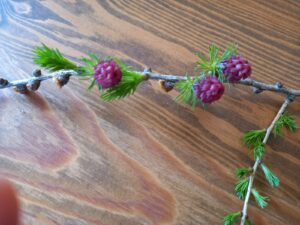
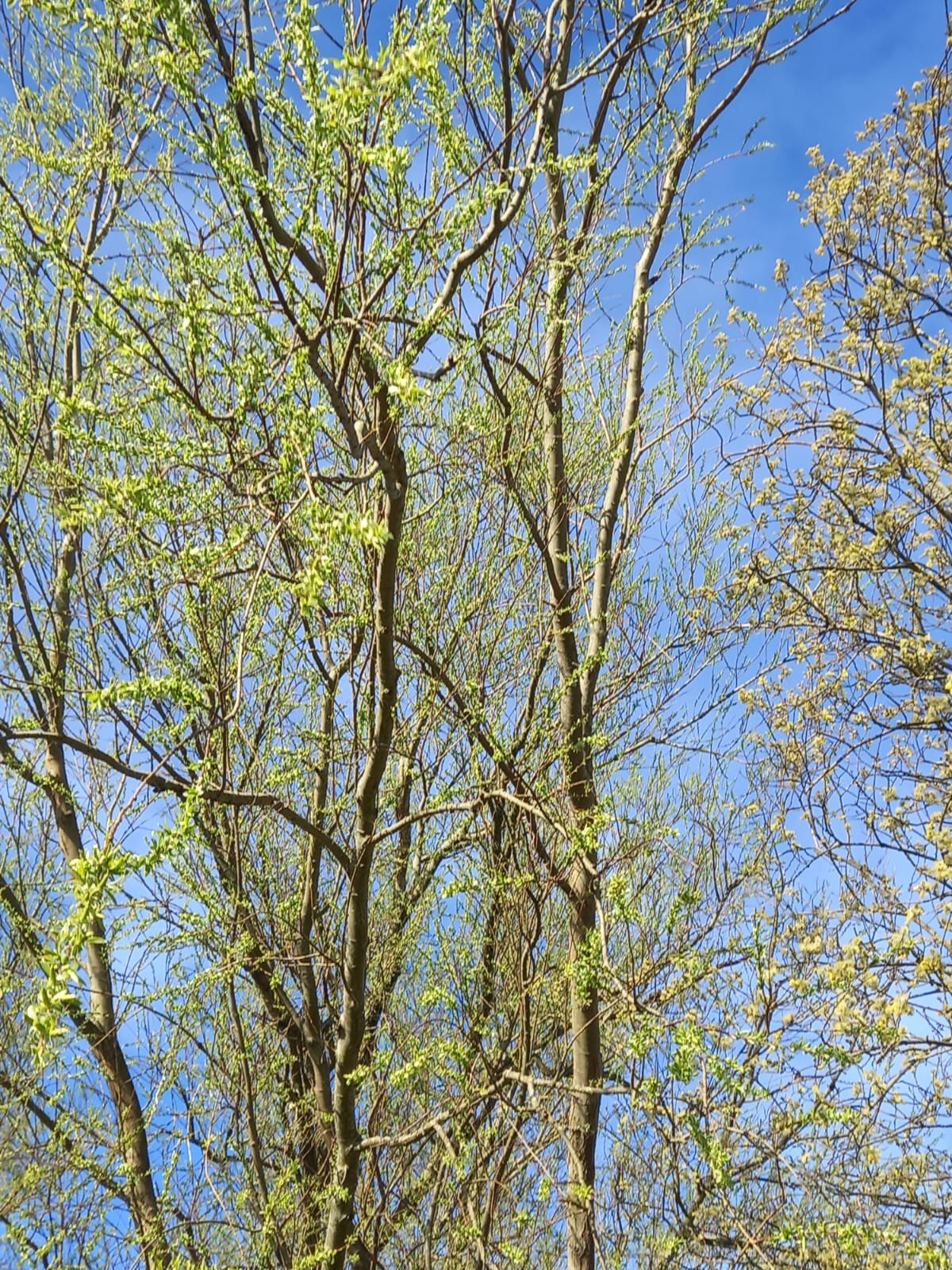
We head up towards a strip of woodland. The new branches of the willow trees have turned a glowing pale brown, bright against the still-lifeless branches of beech and ash. A tall pussy-willow is a glorious burst of silver and gold against the flawless blue of the sky. I start counting the first leaf-breaks. Horse chestnut, always a front-runner, with the first perfect miniature leaves shouldering out of their shiny brown calyx. Hawthorn greening along the hedge-line. Maple, with a little explosion of yellow-green florets. And most lovely, larch with the sudden pink of ‘larch roses’ along the greening branches – the miniature fir-cones of the female flower, and beneath the branch, the dusty yellow buds of the male.
This wood we are scrambling through conceals unexpected traces of the past. In amongst the scrubby vegetation, there is a concrete platform covered in moss and brambles. There is fallen brickwork with saplings growing through it, and a strange hump-backed building heaving out from beneath the wild garlic. They are echoes, not of settlement, but of war. Not far from here there was a WW2 airfield and these ruins, concealed now in the trees, are the remains of an air-raid shelter, a gun platform and brick huts. The trees have been left to grow through and among them. Primroses flower behind the air-raid shelter and a deer path winds through the forgotten encampment. The air space above is patrolled now not by Spitfires, but a pair of buzzards; wide-winged shadows, ominously dark till the sun catches their breast feathers in a sudden gleam of white. They loop and circle languorously on the thermals, then hang motionless to scan for prey,
Their fierce kaa-ing cries echo above us as we pick our way along the track. Chief is agog at a distant sighting of a two deer leaping away through the oilseed rape on the other side of the fence. The far end of the strip is blocked with thickets of bramble, so we take a heady leap over the ditch – ‘wait, wait…NOW!’ – and we jump as one. Back out into the fields and on our way.
I am reading Rooted by Sarah Langford at the moment. It is both a personal memoir of her re-discovery of the countryside, and a passionate advocacy of regenerative farming. She recounts that when she first arrived at their country cottage with two small children in tow, eager to learn more about her surroundings, she starts reading nature books. She remarks:
I often wonder how the writers can go for such long walks without other people needing them. How are they free to stride into nature for days, weeks, years at a time so they might describe it to me? Maybe there is a silent supporter left at home with weaning spoons and potty-training pants and a Calpol syringe lost down the side of the sofa…
…my ways of experiencing the countryside are different from the ones in the books I read. Our walks are speed-limited and unsilent. We are bound to the fields at the back of the cottage, for that is the distance that little legs can walk. So instead I begin to learn every inch of them. I learn what they look like at dawn and mid-afternoon and in the summer dusk or in the cold indigo of twilight. I learn to notice new leaves or blossoms where there had been none. I see how the shapes change with the seasons.’
I relate to this. Although my hound’s legs are long and his stride loping, we nevertheless revisit the same fields, the same woodlands, the same river, day after day. His enthusiasm never wanes. Every morning around 8 we set off at a brisk trot on our daily round, whatever the weather, whether moon-set or sun-rise, drought or flood. I have become intimately acquainted with every hedge and field margin, every contour, every view of the land around us and every day witness the changes that continually occur. Slow, almost to stasis, through the long winter. Now, amazingly fast, as the green fuse of spring is well alight, and every day brings new leaf and flower. I don’t hanker for novelty or change, although we constantly look for new adventures on our patch. Intense familiarity with a particular patch of land is deeply rewarding. Although the wide arable fieldscapes are diversity deserts, there is wild nature too, in the pristine cliffsides of the Whiteadder valley.
Of which, more to follow!
Fascinating description of Spring coming , Kathy.it really brings your surroundings to life. I will read some more. Write on / right on !